Showing posts with label Architecture. Show all posts

Thursday, December 24, 2009

Christmas eve

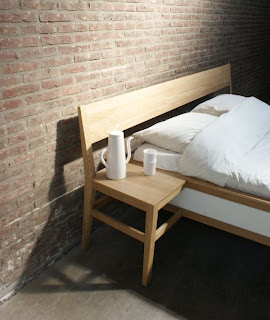
Dutch designer Mieke Meijer has created Blend, a fusion of a bed and chair.

Mieke says:

The chair refers to the 17th century, when people slept semi-sitting up because laying down was associated with death. The chairs now function as night tables.

Enproyecto Architects have completed a monument in recognition of Spanish film director Pedro Almodóvar, located in his hometown of Calzada de Calatrava, in the heart of the community of Castilla, La Mancha, Spain.

The project was the winner of a competition launched by the community government to pay tribute to Almodóvar’s film work and to make references to the culture and landscape of La Mancha. The main idea of the project was to frame the land of La Mancha, as if it were a fragment of one of his films.


Sunday, September 20, 2009

Living bridges

I do hope this is not a hoax or anything, because it is lovely.


North-Eastern India is one of the wettest places on earth. There bridges aren't built - they're grown.


The living bridges of Cherrapunji in India are made from the roots of the Ficus elastica tree. This tree produces a series of secondary roots from higher up its trunk and can comfortably perch atop huge boulders along the riverbanks, or even in the middle of the rivers themselves.

Go to http://rootbridges.blogspot.com/ to see more pics.

Sliding house

Inspirational.


The Sliding House, by dRMM Architecture, may look like a simple timber barn or shed, and you may not be impressed by it — until you discover that it contains a surprise within it. The design of this home is so unique that, well, there is no real actual architectural term to describe it. In fact, the best way to describe it is to say that the house slides!


You see, what appears to be house’s exterior walls and roof are actually a second skin that slides across a longitudinal axis to reveal a second facade. Sliding back and forth, the mobile exterior offers the house’s residents incredible flexibility with the look and behavior of the building. The lighting and mood of the interior spaces can be altered with the simple movement of the exterior. The building’s architectural trick also mean the heating and cooling loads of the house can be manipulated throughout the year.

The house was designed by London-based practice de Rijke Marsh Morgan for a client who desired a retirement home. The house is made up of three buildings arranged along a longitudinal axis, with a garage set perpendicularly, off to the side. A small patio was located in front.

Glass and red rubber work in unison with the timber of the roof/wall enclosure to create a pleasing and unassuming shape that resembles the barns and sheds of the rural countryside. The entire house sits on a concrete bed, which partially hides the surprising mechanism that allows the home to reveal a second facade.

If achieving a flexible outcome within tight planning constraints is truly the hallmark of a great architect, then dRMM architects can clearly take a bow. We absolutely loved this one.

Text from inhabitat: http://www.inhabitat.com/2009/02/20/residence-sliding-house-drmm/

Architect: drmm - http://www.drmm.co.uk/

Thursday, August 20, 2009

Archi blink.

Below taken from BldgBlog http://bldgblog.blogspot.com/2009/07/architecture-of-blink.html

An article posted today on New Scientist suggests that, over the course of a 150-minute film, audience members will miss an incredible fifteen minutes simply through the act of blinking – but also that people watching a film tend to blink at the same time.
It's called "synchronized blinking," and it means that "we subconsciously control the timing of blinks to make sure we don't miss anything important" – with the addendum that, "because we tend to watch films in a similar way, moviegoers often blink in unison." That is, they blink during "non-critical" moments of plot or action, creating a kind of perceptual cutting-room floor.
On the one hand, then, I'm curious if this means that clever editors, like something out of Fight Club, might be able to insert strange things into those predicted moments of cinematic calm – moments deemed safe for blinking – simply to see if anyone notices, but I'm also left wondering if there is an architectural equivalent to this: a spatial moment inside a building in which it seems safest for us to blink.
In other words, do people not blink when they first walk into a space like Rome's Pantheon or into Grand Central Station – or is that exactly when they do blink, as if visually marking for themselves a transition from exterior to interior?
It would seem, then, that if film has moments of synchronized blinking, then so might architecture – but when do we choose to blink when experiencing architectural space, and do those moments tend to occur for all of us at the same time?
How could we test this?

Further, if there is, in fact, a moment inside a building somewhere where almost literally everyone blinks– say, in the lobby of the Museum of Modern Art, or in a bathroom corridor in the history building at your own university – could we say that that space is somehow yet to be fully seen?
It is the spatial equivalent of those fifteen minutes of a film that no one realized they missed.
After all, perhaps there's a detail in your own house that you've never actually seen before – and it's because you tend to blink as you walk past it. Your own body assumes, outside conscious awareness, that this must be a safe space for blinking; it's near a window, or the colors are very dull. Perhaps that's how spiderwebs build up: you literally don't see them.
On a much larger scale, meanwhile, are there stretches of highway somewhere outside town where the scenery gets a bit boring – and so everyone starts to blink, more or less at the same time, thus visually removing from collective cultural awareness that McDonald's, or that abandoned house, tucked away over there beside the trees?
And could you locate that exact moment of blindness – could you find blinkspots throughout the urban fabric – and start to build things there? Architecture becomes a three-dimensional test landscape for the neurology of blinking.

For instance, if people driving 65 mph travel, say, five feet with every blink, then what spatial and architectural possibilities exist within that five feet?
What are the spatial possibilities of the blink?
I'm reminded of certain zoning laws in which you need to consider the exact amount of shadow your building will cast on the neighborhood around it before beginning construction.
But what about zoning for blinks? Can you zone a building for maximum blinks?
Or perhaps the opposite: a new genre of architecture, specially designed for Halloween fun houses, in which it's too stressful to close your eyes even for a micro-second...
Sunday, May 24, 2009

Bri(n)ck

Bri(n)ck at Graduate School of Design, Harvard University

I don't really like brick.. It's generally so solid and boring. I do like the uniformity of it... That sense of order. And it's warm. This particular design shows how damn CAD can help.. I think this will be an area I'd love and loathe to explore.

Love the curves lines, the play of light and the materiality of it.

Go to http://www.dezeen.com/2009/05/11/on-the-brinck-at-graduate-school-of-design-harvard-university/


Saturday, May 23, 2009

Saturday, March 21, 2009

Food for thought


Rather late, but here's the entrants for the Architectural Jelly Competition -
http://www.lfa2008.org/event.php?id=130&name=Architectural+Jelly+Banquet


How cool is that? Visit http://www.dezeen.com/2008/07/22/architectural-jelly-competition-results/ for more.

Thursday, March 27, 2008

Amazing

I came across this marvel. (Picture on Right) And since I got the picture from flickr, I'm not too sure of the credibility of it.. But, pictures 4, 6 and 7 take my breath away.

It just CAN'T be real right?!!!

Also, there's this building in Dubai, the Shuffle Tower. It can change it's shape.

I'm still not sure to what extent it can change, and from the little I've read it only moves so that the views change. While I think the building is lacking aesthetically, imagine the possibilities! It's just mind-boggling. Built by James Law Cybertecture, it's supposed to be ready by 2009 and is an all-in-one from a mall at the base to offices in the middle and then residences at the top.

http://www.jameslawcybertecture.com/